Abstract
Robotic surface operations require complete coverage even when people or objects temporarily obstruct the tool or the arm. ReCover combines whole-arm model predictive control with a coverage ledger that credits executed motion and a supervisor that decides when to wait or switch to a reachable, uncovered stroke. The supervisor estimates the cost of switching without a forecast of the intrusion. A distance field built online from depth images supplies obstacle information. In scripted intrusion tests on a UR5, ReCover completed all 15 runs and reduced completion time by 6.9 seconds on average relative to Stop-and-wait. With live depth sensing, the robot completed 13 of 14 contact erasing runs under unscripted human intrusions. Contacts observed when obstacles were absent from the map highlight the importance of perception coverage.
All videos play at 2× speed.
Board Erasing Demonstrations
Under unscripted human intrusions, ReCover adjusts whole-arm motion to give way and switches to reachable strokes when the current region is blocked. The robot makes progress while the obstruction persists, then returns to the interrupted strokes and completes the entire wiping task. The videos show each run continuously from the first stroke to the clean board.
Method Overview
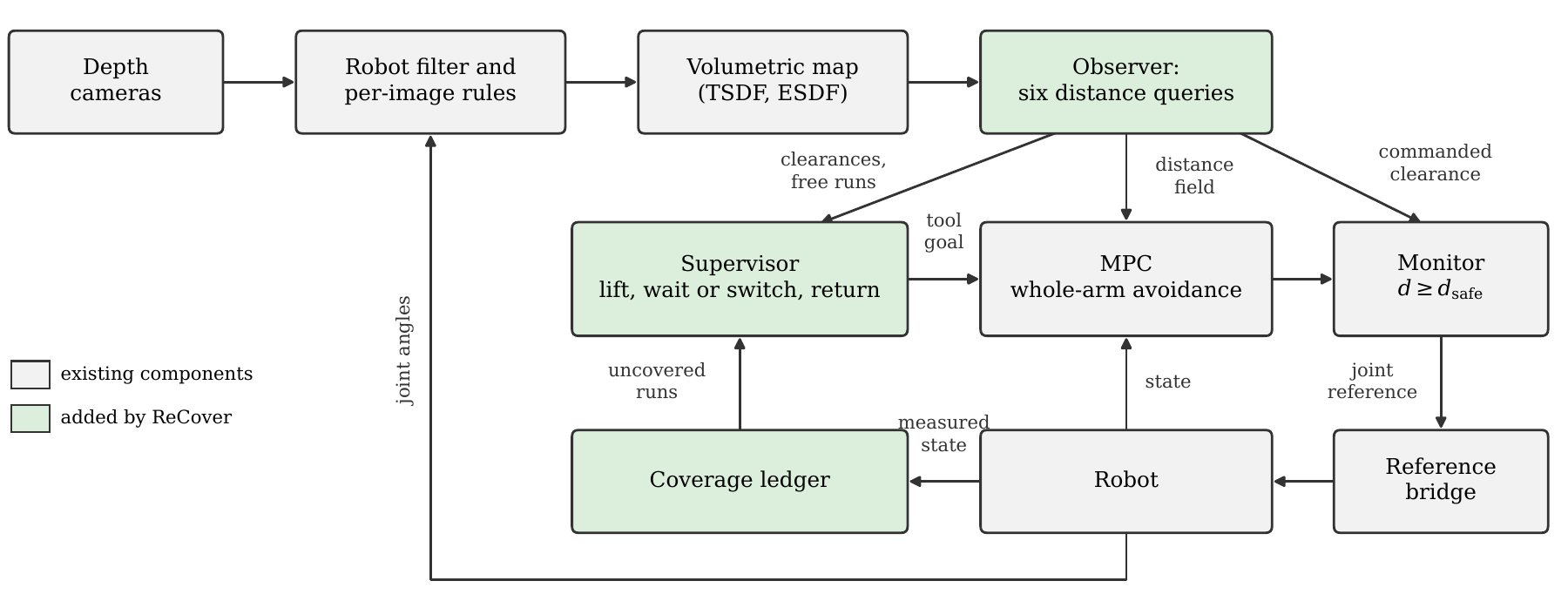
The coverage ledger tracks executed work. The supervisor uses the live distance field and uncovered strokes to decide when to lift, wait, switch, or return.
Dynamic Collision Avoidance
Safety is central to human–robot interaction. Depth cameras update the scene map in real time, enabling the robot to adjust its whole-arm motion as an unmodelled hand enters the workspace. In this pose-holding run, the UR5 gives way to repeated approaches and returns to its held pose.
Real World Evaluations
Virtual-Reality Arm Intrusion Tests
The physical UR5 follows the prescribed strokes above the board while scripted forearm intrusions are rendered in the Digital Twin. The five videos show separate ReCover runs in full.
Compare responses to the same intrusion
Choose a pattern and a baseline to see paired excerpts from the same interval of task time.
Watch the switch. ReCover moves to an open stroke while Stop-and-wait holds at the blocked section.
In P1, ReCover finished 10.7 s sooner on average than Stop-and-wait.
Playback could not start. Use Open clip to play a video directly.
Across the five patterns, ReCover saved 6.9 seconds on average against Stop-and-wait. Immediate replanning had similar overall completion time.
Hand-Placed Object Obstruction Tests
A person places a can at successive locations along the coverage path. The robot responds to the object and the person using live depth sensing. The videos show all three ReCover repetitions in full.
Compare responses to the placed object
Select one of the three placement marks and a baseline to compare how the controllers respond to the obstruction.
Watch the first obstruction. Compare how each controller moves the tool while the can stands on the first mark.
Among completed runs, ReCover averaged 4.8 s less than Stop-and-wait.
Playback could not start. Use Open clip to play a video directly.
ReCover and Stop-and-wait each recorded one contact when the can was absent from the depth map.
BibTeX
@unpublished{li2026recover,
  title  = {{ReCover}: Reactive-Coverage Motion Generation for Robotic Surface Operations under Unmodelled Dynamic Intrusions},
  author = {Li, Yichuan and Huang, Tianyu and Sui, Congying and Chen, Wei and Liu, Yun-Hui},
  year   = {2026},
  note   = {Manuscript}
}
Acknowledgements
We thank the participants who assisted with the real-robot experiments.